Interview by Thomas Rotolo and Safiya Hafiz
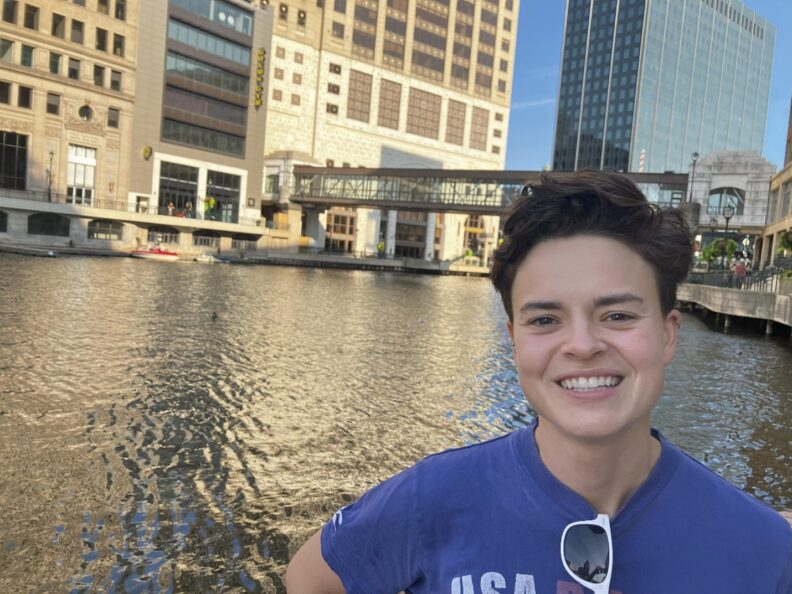
At the start of the fall semester, we caught up with Anne Johnson, a newly hired Scholarly Assistant Professor in the Department of Sociology at the WSU-Vancouver campus.
Thomas Rotolo: Thanks for taking the time to talk with us. What initially drew you to sociology?
Anne Johnson: My path is less traditional than other people who take a sociology class in high school or college, fall in love with the discipline, and then find a research interest within sociology. My academic background is broad, so as an undergraduate, I earned a Bachelor of Arts in Global Studies and had five different minors in the humanities. Then, I earned a master’s degree in English.
Between undergrad and graduate school, I was a phlebotomist. I was drawing blood at a clinic, and I found the social space of a blood draw to be one of the most interesting that I had ever been a part of, particularly because of the dynamics between me as a phlebotomist and the patient. I couldn’t stop thinking about phlebotomy as an important social site.
When I was deciding what I wanted to do next in my career, I talked to a former mentor and teacher, Emily Kazyak, at my undergraduate institution, the University of Nebraska-Lincoln. I asked , “Do you think sociology is broad enough to allow me to study phlebotomy?” Her reply was that sociology is a large, inclusive, welcoming discipline in terms of what you can study. If you can make a case for why it’s important, you can study almost anything. And so that’s how I came to sociology. I knew what I wanted to study, and sociology would help me get the analytical and theoretical tools to put it into context.
Thomas Rotolo: What were your next steps after you got the green light from a mentor to pursue graduate studies in sociology?
Anne Johnson: I was place-bound when I was considering this career pivot into sociology. Before applying for graduate school in sociology, I thought that I was going to be a therapist, like a marriage and family therapist, and I was enrolled in those classes. My wife, who at the time was a professor at Indiana State University, got a job offer at WSU-Vancouver, and all her family lives in the Willamette valley. It was a no-brainer that we would leave Indiana and come to Vancouver. Portland State University was the only Ph.D.-granting institution in the area, and so I crossed my fingers and tried to put together a compelling application, and very luckily, they decided to take a chance on me, someone with a very bizarre research interest who would sort of need training to become a sociologist.
Thomas Rotolo: Speaking of your so-called bizarre research interest, tell us about your research. What is your primary researcher interest and how do you situate it in sociology?
Anne Johnson: I began focusing only on medical phlebotomy, and I was interested in the patient experience of blood draws. Phlebotomy is such a central diagnostic tool, especially in primary care, for trying to assess what additional care you might need. There’s not a lot of social science research in this area, and there’s some evidence that shows that people who have high rates of needle fear may avoid medical care because they don’t want to get a blood draw. Initially, my argument was trying to fit it within the medical sociology framework about why we need to pay attention to one of the most ubiquitous and commonplace invasive techniques that we have in medicine.
A year or so into my Ph.D. program, I stumbled upon an article about law enforcement phlebotomy, when police officers are drawing blood from drivers they suspect are impaired. That was a much easier topic to study within sociology. I didn’t need to convince anybody that it was important to study the police co-option of a medical tool for law enforcement aims. Additionally, I had tons of questions about that policing practice. I built my dissertation along two veins, if you’ll pardon the pun.
First, I conducted a patient experience interview study, where I talked to people about their purely medical experiences of getting blood drawn. Then pivoted the rest of my dissertation to an interview study with law enforcement phlebotomists to understand how they make sense of this policing practice. I uncovered how law enforcement phlebotomists view training standards, how they should or shouldn’t use force, and how they think about their use of this medical tool for policing aims. None of these insights implied they don’t support law enforcement phlebotomy, but they want to protect it against external criticism. So, it was interesting to see how their views about phlebotomy were intended to make this tool stronger and more embedded within the policing institution.
Because there really isn’t much research on law enforcement phlebotomy, I wrote a conceptual, theoretical article that set out some of the fundamental questions about this policing practice. That paper is currently under review. I also conducted a Foucauldian discourse analysis about how newspaper coverage has portrayed this policing practice. It won’t be a big surprise, but newspaper coverage is heavily influenced by police press releases and from the police perspective. The coverage tends to conclude, “This is great. All cops should be drawing blood. This is only going to benefit public safety, it’s helping you as the driver.” There are no conflicting or complicated views, and no accounts from people who’ve had their blood drawn by police.
Safiya Hafiz: How did your recruitment of participants into your study proceed? Was this a hard population to get into?
Anne Johnson: I was worried, and so was my committee, to be honest, that I would not be able to recruit enough officers for this to be a robust study. My research question was about a universally reviled driving practice. Nobody thinks that drunk driving is a good thing, right? That’s an easy, social issue to find unanimity around, and so I think the police were happy to discuss their approach to combat impaired driving, and because that felt like such a clear moral good. They were much more willing to talk about that, rather than if I had asked them about a more socially controversial topic in policing.
I had my own techniques for making participants feel comfortable as I introduced the interview to them. My strategy for talking to people on the phone or in a Zoom interview, especially if we don’t have any rapport built, was to start with something silly. I’m a big college football fan. When interviewing someone from a state where there was a big college football program, I would begin by pretending that I had this really high-stakes question to start. Something like, “Okay, I’ve got something to ask you, and this might be the end of the interview, but are you…(dramatic pause) a Minnesota Gophers fan? My Nebraska Cornhuskers are playing your team on Saturday, and if that doesn’t go well, I don’t know if we can have a serious discussion.” I would make this joke, and I think it surprised them and broke the ice. Most of the time they were football fans, and so we were sort of able to build rapport that way. In the end, I had a ton of rich, qualitative interview data, but I finished my interview project thinking, this is just barely an answer to my question. I still have a lot of interview data. There are many future research avenues that I’m excited to pursue.
Thomas Rotolo: What does the future hold for you as a career track faculty (Scholarly Assistant Professor) at WSU Vancouver?
Anne Johnson: I’m thrilled and grateful to be part of the sociology department at WSU more generally, and located on the Vancouver campus with professor Alair McLean. I think it’s wonderful to increase the presence of sociology on WSU Vancouver and attempt to increase undergraduate majors and minors who are interested in sociology in Vancouver. I’m teaching primarily gender and sexuality classes. The link between my teaching and my research involves a fundamental concern with power, and how power works in different contexts. I’m often concerned about how those in power yield it, what tools they’re using to wield it, and being able to assess that sociologically through their discursive strategies, for their actual physical practices and their embodied ways of being in the world that perpetuate or resist that kind of power. I want to address how the people experiencing the effects of that power are negotiating those circumstances.
I’m applying for some grants right now, one, to hopefully hire a research assistant in our department, and then, conduct an ethnographic pilot study, within a police station somewhere in the Pacific Northwest. There are a lot of police stations that have law enforcement phlebotomy. It is important to understand how those in power are justifying their use and expansion of the tools that they use. And we know almost nothing about the people who have had their blood drawn by police. An ethnographic kind of study to see if it’s possible to witness the blood draw, to be present on patrols and traffic stops to observe the entire interaction as it occurs is going to be illuminating and will address some of the limitations of my interview study. Additionally, I actually have a really exciting potential collaboration with some engineers at the WSU Vancouver campus who have found a way to develop microneedles with biosensors. And so, we’re talking about maybe submitting an NSF grant to try to develop the technology to test for different intoxicants. If this technology works as expected, it would address some of my fundamental concerns about law enforcement phlebotomy is currently designed.
Safiya Hafiz: Last question, it pivots from research to teaching. How would you describe your teaching philosophy?
Anne Johnson: The way that I approach my classroom also relates to power. Many instructors view the teacher as the knowledge granter, and the students as the blank slates who receive all your information. I try to emphasize for my students and through my assignments that their lived experiences are valuable and contribute to our classroom environment. The way that they engage with the things that we are reading and with each other is what makes them richer and helps them become applicable. It’s not just, “you read this article, what do you think about it?”
Making connections among students particularly, is important. I always do some community-building activity each week on the last day a class is held. It’s always a different activity, but the goal is a very low-stakes way to get to know each other. I have found that that makes a big difference in helping people feel comfortable showing up and helping them be comfortable in uncertainty. For the students, if they know a little bit more about their peers, if they know a little bit more about me, if everybody’s going to be excited when they all show up, all the multiple identities that they bring to a classroom, that shows that they are all welcome. And we’re learning together.