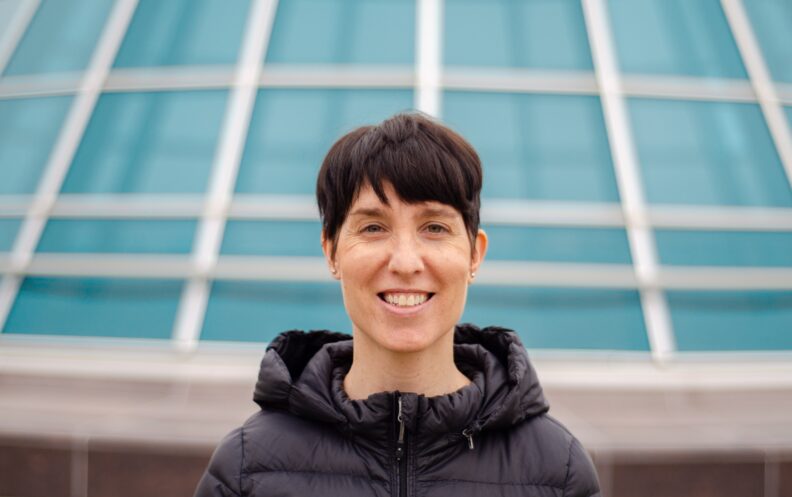
In this Alumni Spotlight, we catch up with Assistant Scholarly Professor Kristin Cutler, who graduated with her PhD from WSU in 2013. Kristin is the current director of the online global program.
Thomas Rotolo: Please tell us how you ended up at WSU? What led you to become a sociologist and get a PhD in sociology?
Kristin Cutler: I started my graduate career in the criminal justice department at WSU. My undergrad degree is in criminal justice, and I had a mentor in undergraduate school at the University of Nevada, Reno with a degree from the WSU criminal justice department. That’s how I ended up at WSU. Then, I took Greg Hooks’s graduate class in Sociological Theory as an elective and I ended up enjoying it. It was very challenging, but I enjoyed it. And we had an oral final exam, which was highly nerve-racking for me. I wasn’t sure how I performed on the final exam.
After the final, Greg asked me, “Hey, Kristin, any interest in jumping ship over to sociology? We have a TA slot available, and if you’re interested, it’s yours.” My first thought when he asked this was, “Well, I must have done well in the class! Also, I was excited, because while I was enjoying my time in criminal justice, it focused on things like policing, corrections, and the law. I was more interested in the theories. Why is crime occurring? I knew that the department had a strong criminology legacy, with professors like Jim Short (who the Wilson-Short building is named after) and Charles Tittle. And I knew there were some great up-and-coming professors, like Professors Jen Schwartz and Clayton Mosher, who ended up becoming my mentors. It was a no-brainer for me: yes, I will take the TA position, and that’s how I ended up in sociology. I knew that I was still going to be able to study crime and deviance in sociology, so I wasn’t totally giving up my roots.
Thomas Rotolo: So, what year did you start the sociology program? As you explained, you took Greg’s class.
Kristin Cutler: I joined the 2003 cohort. I can’t believe I’m saying that. It’s so long ago. I started the year before that in the criminal justice program, and then the next year I came over to sociology.
Thomas Rotolo: So, Professor Jen Schwartz was your PhD advisor?
Kristin Cutler: Yes, she was my PhD advisor, yes. She was my mentor in graduate school, on the job market, and now she is my primary mentor as I’m going up for promotion from Assistant to Associate Career Track Professor.
Thomas Rotolo: Why don’t you tell us about your career path?
Kristin Cutler: I graduated with my PhD in 2013, so I was in the department for quite some time. And over that span of time, I did a lot of teaching. I think I was teaching my second semester in the department, so pre-master’s degree. My first teaching assistantship was with Professor Lisa McIntyre in the large SOC 101 class, and I was a discussion leader. Then I taught my own SOC 101 class the next semester.
I taught for the entirety of my graduate career. I think there was only one other semester where I went back to being a TA for Lisa. But otherwise, I was teaching on my own. After SOC 101, I taught Juvenile Delinquency and other deviance and criminology courses. Those courses were in my area of study, but I also taught courses like undergraduate theory and methods. I had a wide range of teaching, including a teaching fellowship for two years in the department. During that time, I became involved with other teaching related tasks like assessment, student recruitment, the Sociology Club, and online courses with WSU Global campus. I had a lot of preparation in terms of going on the job market, because I was looking for teaching jobs, even though I had a very strong research record.
I was successful on the job market. I had many interviews, and I got a couple of different offers. My spouse (Joseph Kremer, WSU Sociology PhD 2015) was also on the job market, and we had a decision to make. Who’s going to take a job? Joseph took an academic job, and we moved to Iowa, but I kept teaching for the WSU sociology department through Global Campus. At that point in time, we didn’t offer a complete online degree. The department was teaching core courses, like SOC 101, SOC 102, and research methods.
During the two years that we were away, I developed online courses in theory and juvenile delinquency. I was still connected to WSU, and to WSU sociology when we decided the Midwest was not the place that we wanted to be. In around 2018, we decided to come back to Pullman for a visit because we still had friends here. We realized that we really missed the area. We missed Pullman a lot and we missed the Pacific Northwest. I heard that there might be a position for a faculty member in sociology to become involved with Global Campus because the department wanted to have an undergraduate degree online. I thought I would be a good candidate because I, probably more than anyone, understood how the department and Global Campus were connected. The department needed someone to oversee and direct the Global degree in Sociology. I was very happy to take the position, and overseeing and directing the Global undergraduate program is primarily my service requirement. I also teach three classes each semester, so I usually split that between in-person and global teaching.
Thomas Rotolo: What is your exact role in the department now?
Kristin Cutler: I’m a scholarly teaching assistant professor, and the director of our online global program. And so, as director of our global program, I oversee all the development, revision, and teaching of our global courses. I also evaluate global teaching, especially graduate instructors. I do evaluations on their teaching. I do all the onboarding of those that are new to teaching for Global, and that includes tenure-track and tenured faculty members. I make sure that our courses are getting offered enough so students who are earning degrees online can do so in a timely manner. Finally, I keep up to date with any changes to Global Campus courses, because the system is constantly changing and growing. That’s one of our biggest challenges right now — the rate of growth in Global Campus enrollment. The department must make sure it offers enough courses we offer, and it must have enough qualified instructors to teach those courses. And, we need to update those courses every 3 to 5 years, which is challenging because when we have all these different formats of courses. This means we constantly have to think about how we structure our courses so that the courses are not completely overwhelming to those that are teaching them.
Thomas Rotolo: Why don’t you tell us a little bit about your new on-campus courses, such as the mindfulness class?
Kristin Cutler: There are a couple of different things that I’m doing in that realm. Sociology 103 is our Social Psych of Communication class, and that was originally a class that Christine Horne developed a few years ago. Part of that class was intended to help students with stress management, and another part is helping them to become effective communicators, to have their ideas stick in the minds of others, to get them to effectively communicate across differences. Joseph Kremer started teaching the class and I thought that this would be a good opportunity to rework that part of the class, using what I know about mindfulness. We applied and were awarded the Smith Teaching and Learning Grant to develop the curriculum in the course. So, I helped him develop the mindfulness curriculum, and he’s taught it for years, but this Fall 2025 semester I’m teaching it. Half of the class is learning about mindfulness-based social-emotional intelligence and providing students with tools to become more mentally and emotionally resilient people.
Thomas Rotolo: When you’re not teaching or dealing with Global Campus course, what do you like to do?
Kristin Cutler: Raising 3 small children is one of the things that I spend a lot of time doing. I have a 7-year-old, a 4-year-old, and a 1-year-old, all boys, so it’s controlled chaos. When I’m not doing that, and I’m not up in the department teaching or doing things related to sociology, I’m at the local yoga studio, teaching yoga and mindfulness. Lately, we’ve been doing yoga with the WSU football team which has been, a rewarding experience. The coach contacted the studio and said, “Hey, I’d like to get my players into the hot room, helping them to develop a yoga practice and a mindfulness practice. I try to make it a space where they can relax, not worry about competition, and just be in a space that lets them be, as opposed to having to be on. Some of the movements will benefit them physically in terms of injury prevention and will help them become better athletes if they take it seriously. But, I think the mental and emotional aspects are more important.