Richard York returns to Pullman as part of the 100–year celebration
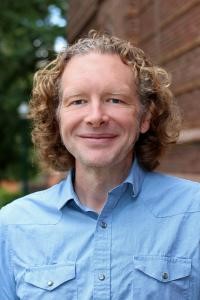
A scheduling conflict got in the way of Richard York’s (PhD, 2002) planned visit to WSU for the centennial celebration last year. Fortunately, we made up for this with a visit in October. Before Richard arrived for his visit, we asked him to reflect on his time as a graduate student in the Department of Sociology at WSU.
Tom: The schedule last spring didn’t work out, but the department is excited to have you back to campus for the 100–year celebration of the department of sociology! Tell us about some of your memories of being a graduate student at WSU.
Richard York: I had a really good experience at WSU. I was only there four years, but that is a good sign because I progressed through the program quickly. I was there at a kind of golden age of environmental sociology.
The faculty were very senior. The department at that time was at a peak with some of the most prominent senior level environmental sociologists in the field. It was an ideal place for someone like me, given my research interests as a graduate student.
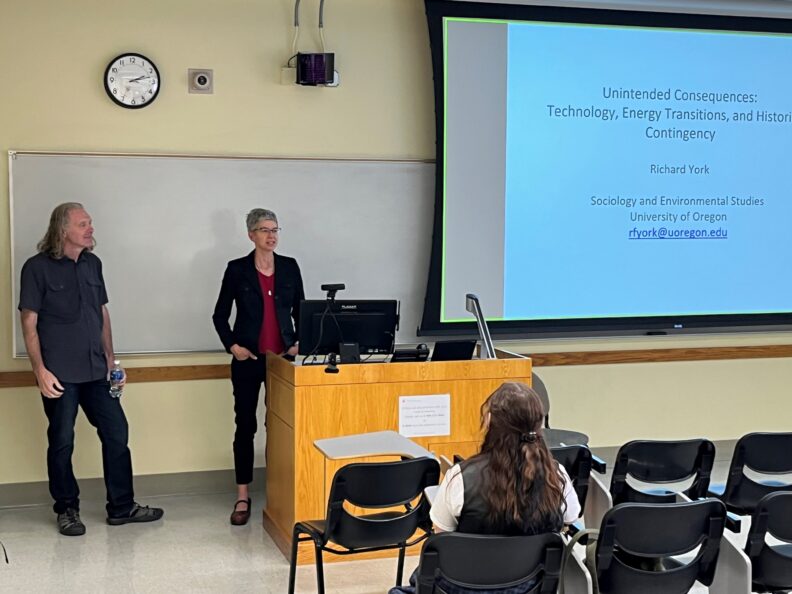
I received a very good education. For instance, I received excellent statistical training, but WSU went beyond that and offered a good education more broadly. That’s not only for people who are like the “quant nerds” who are only going to do quantitative research and take endless statistics classes. I think of people like Greg Hooks who taught in a theory class in a thoughtful, dynamic, and engaged way. The department was very innovative and interesting. The department instilled confidence because the faculty had such high standards.
This made for a remarkably strong sociology program, but it was unlike the larger graduate programs elsewhere. WSU Sociology was a place where you got to know people. There was a divergence from rigid conformity to the mainstream, and I think that really helped me because I have such an interdisciplinary background and doing environment was kind of an odd thing in sociology at the time. Since then, environmental sociology has become well established. But it was still kind of peripheral at the time I started at WSU.
I believe the informal part of graduate school is much more important than the formal part. It’s people coming to the department, chatting with people, asking questions and then trying to figure things out. It made for a very good intellectual community.
I was very lucky to work with Gene Rosa. He obviously was central to my program of study at WSU and my career. Gene was extremely supportive, and I appreciated that. Gene set seriously high standards, so it was always: “Let’s do some great work.” I have wonderful memories of our work relationship. Having grown up in smaller towns, I quite liked Pullman. I grew up and I went to high school in Roseburg, Oregon, and then I was at Bemidji State University (in Minnesota). I would have been very intimidated by a big city.
Tom: What was central to your success at WSU?
Richard York: I have tried to take care of my grad students, and I think that was because I had a mentor like Gene Rosa who supported me and who stressed how important that type of support is. Gene taught me that academia was, in some ways, like a trade where you learn through the mentoring relationship. Yes, you need to have the classes to get the basics. But how do you do what we do? How do you think of ideas? There’s not a rigid formula for research. It’s just a willingness and interest to engage. I found engagement was central to my own success. Of course, I wanted to impress Gene because he was a senior figure in the department, and I’ve tried to emulate that approach throughout my career. I put a lot of effort into my graduate students as I teach them the trade of being a researcher. How do you write an article? How do you submit an article? How do you strategize about where you’d send it? There’s not a singular way to teach that, but Gene was very good at answering those types of questions.
Additionally, Gene’s focus was always interdisciplinary. He was a weird sociologist, and I mean that with the highest praise. He aimed his work at natural science or general science audiences across disciplinary audiences. He didn’t think in the small, narrow rut of what many people think sociology should look like.
Yes, you need to publish and publish in certain ways to get jobs and have a career, but research is a fun activity. We’re intellectuals. We get to ask questions and work out puzzles. I like thinking about things; I like reading; I like coming up with ideas; I like talking to other scholars; I like engaging with the research community, and Gene had this same approach. His willingness to put time and effort into those activities inspired me. Gene modeled this approach for his students. It was remarkable.