Introducing the new grad student cohort!
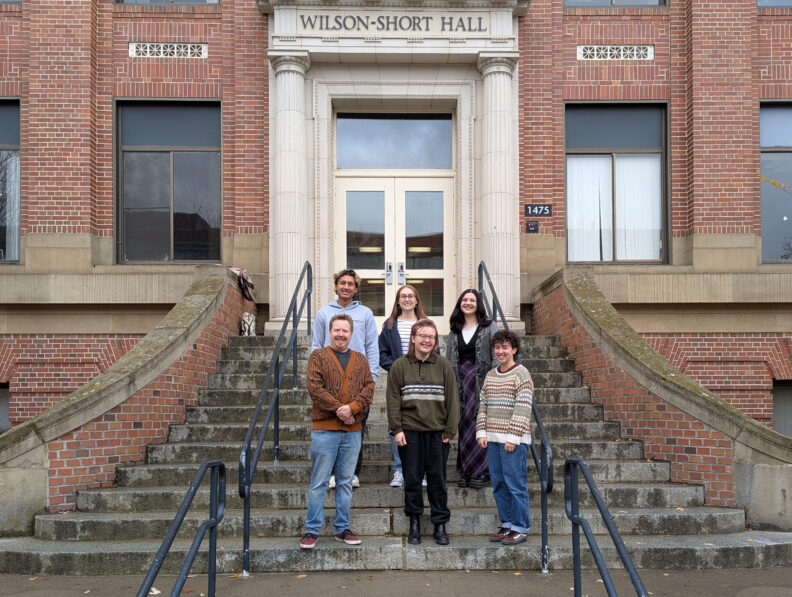
This fall, our department welcomed six graduate students to the 2024–25 cohort. Below, we learn a little bit about each of them. WSU sociology wouldn’t be what it is without our interesting, curious, and talented new graduate students!
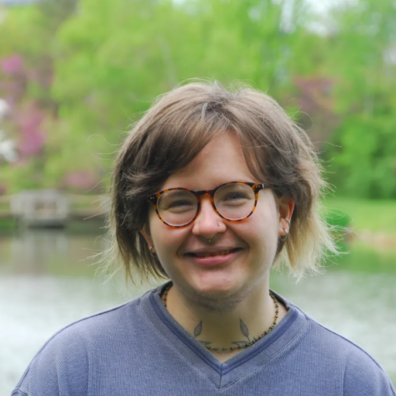
Ash Plummer
Hometown: Ithaca, New York
Education: BA in sociology and music from Ithaca College
Research Interests: mixed methods, rural sociology, poverty, and queer studies
Safiya: Tell us a little bit about your research interests.
Ash: I’m interested in mixed methods research. I’m pulled towards qualitative methods. I would like to focus on rural sociology and poverty, especially of queer populations: whether they decide to or not decide to move to an urban area for social or cultural reasons, and then whether poverty follows them or whether they end up in poverty by staying in a rural area.
Safiya: What is something you have strong opinions about?
Ash: I think people should prioritize caring for the people around them. I think our strongest power is the people around us and the larger support network you can build for yourself. The larger your community, the happier and healthier everyone tends to be. Maybe that’s a common sociologist answer, but this is part of the reason why I love sociology so much, because it showcases that over and over again. It’s one of the things I hope to do with my research and my life.
Safiya: What is something interesting or unexpected about you?
Ash: I really like hand-poke tattoos, and I do them on people when they want them. I specifically give tattoos to people who are trans or low income for free, and then I charge others if they have the capacity. But I really like doing that as a way to connect with the community around me and to share my art. It’s also a very intimate way to get to know a stranger—to give them permanent art on their body.
Safiya: How did you get into tattooing?
Ash: Mostly just being poor and still wanting tattoos. Buying a set of tattoo needles and some ink is much cheaper than repeatedly paying for a piece of art from someone. So, it’s mostly that this is the most accessible way for me to do tattoos on myself, and I’ve always been creative, so this wasn’t super foreign to me.
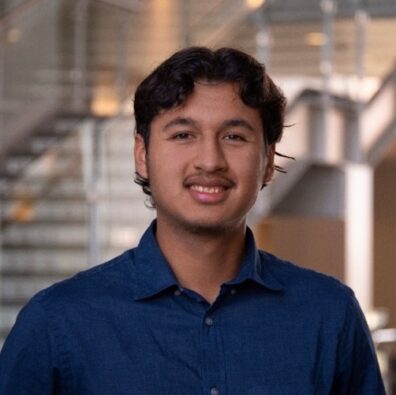
Allan Hernandez Padron
Hometown: Vista, California
Education: BA in sociology and business economics from Beloit College
Research Interests: stratification, inequality, race, immigration, and quantitative methods
Safiya: Tell us about your educational path.
Allan: I remember when I was maybe six or seven, I made a promise to my mom that I would go to college. By the time I was a freshman in high school, I joined this program called A.V.I.D. which is for first-generation, low-income students who want to go to a four-year school. Then around my junior year, I was playing soccer which was a big motivation as I wanted to get recruited. I applied to a whole bunch of different schools across the country and picked Beloit College, which is a small liberal arts school in Southern Wisconsin. It was the best fit since I could play soccer there, and they provided good financial aid. They also seemed like they really cared. As far as the PhD route, I knew from when I was young that I wanted to get a doctorate, but I didn’t know what the process would look like or how to apply. I really knew I wanted to pursue a doctorate degree once I was at Beloit because it has the McNair’s Scholar Program, and the objective is for students who go through that program to eventually get their PhD. After applying, WSU was one of the schools I got into, and after speaking with Erik Johnson and Dr. Raymond Herrera from the GDAPP program, and then meeting all of you on the virtual visit day, I was like, yeah, this is my type of vibe.
Safiya: We’re happy you’re here! How did you decide on sociology?
Allan: My first semester of undergrad, I took an economics course and a sociology class. I noticed that economics seems to be very individualistic. But as someone that faced discrimination growing up, I knew that there’s much more than just the individual involved. I realized I needed to study sociology instead, because it’s not so much about agency or the individual, but about the structure and how that limits us or hinders us in certain ways. The literature on stratification and inequality, and this may sound a little weird to say, but for once, it just seemed like it was about me.
Safiya: You also mentioned playing soccer. Can you tell us a little about that?
Allan: I played D3 soccer in undergrad. Soccer was the only sport I played growing up, because I was from a low-income household, and it’s all we could really afford. I played at a local club in my hometown. I started when I was five or six. My mom kept insisting that I should be on a team, as she really loves soccer and is super passionate about it. I remember on weekends, we’d watch the Mexican League or the Mexican National team together.
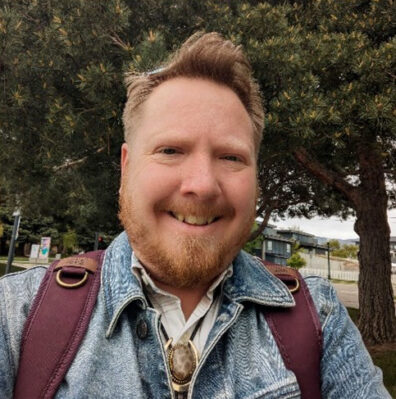
Andrew Myers
Hometown: Bakersfield, California
Education: MA in geography from University of Montana and BA in city and regional planning from California Polytechnic State University
Research Interests: disability and health, data collection techniques, spatial inequality, demography, and geography
Safiya: Can you tell us a bit about your MA?
Andrew: My master’s was in geography, and I was interested in interactions between the natural environment and humans. At the time, there was this debate about wolves being delisted from the Endangered Species Act. There was a lot of debate in Montana about wolf management, and I dove into that discussion and read online comments about wolves and wolf trapping and did a discourse analysis. I looked at our socially constructed ideas of wolves and wolf trapping and how those impacted our ideas and experiences in nature.
Safiya: That is super interesting! Can you tell us about your current research interests and how you got to that topic?
Andrew: I was working at the University of Montana for The Rural Institute, and we were doing some research using paper surveys and I noticed that people kept changing their answers on these disability items and that is not something that is supposed to happen if we think of disability as a stable trait. That led me to connect with some colleagues across the county who look at disability measurement more broadly and are really focused on ensuring that the U.S. Census Bureau and the federal government is collecting data about people with disabilities in an inclusive manner. There’s a really big national debate about this, and it is an issue I really want to address.
Safiya: Tell us about yourself outside of academics. What do you like to do?
Andrew: I really enjoy downhill skiing. I enjoy sliding around on snow in any way, except on ice on the street! I like skiing, cross-country skiing, and sledding. I’ve broken a lot of bones. I like biking, either for commuting or for exercise. I also like small towns and small community-oriented environments. I love pizza, and I make a killer quesadilla!
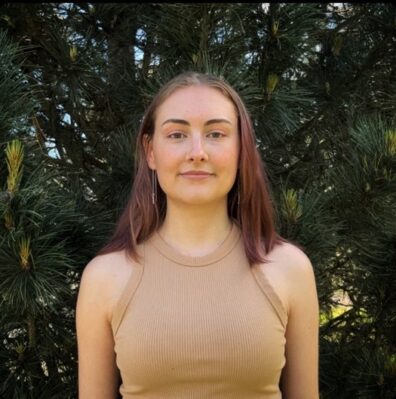
Jasmine Willis
Hometown: Radford, Virginia/ Las Vegas, Nevada
Education: BA in sociology from Washington State University
Research Interests: environmental sociology, sustainability, public opinion, policy, and political ideology
Safiya: Tell us about your research interests.
Jasmine: I’m currently trying to develop a research idea on ambivalence with climate change topics, particularly in local areas—like specific things going on to mitigate issues of climate change. I used to be in the environmental science track, and I gained more of a basic general “sciencey” background, but I realized that its more interesting to study people. I thought it might be interesting to see how issues of climate change would affect various individuals and groups. I was recently introduced to this issue of windmills and solar panels going up in the Palouse and various opinions on whether or not they should go up or what land they’re going to go on, so I might do something with that.
Safiya: What is something you would recommend to everyone? Like a TV show or a movie?
Jasmine: I would recommend watching Monty Python’s Flying Circus series. I feel like, as a sociologist, it has a lot of humor in it that people in sociology would find pretty funny. That being said, it is a pretty old show, so you have to keep in mind that you might encounter some things that would not be acceptable in this day and age. But I still think it’s a super funny show, and it has a lot of commentary on the inner workings of social life.
Safiya: What else do you enjoy doing in your free time?
Jasmine: I don’t think people expect this from me because I’m really tiny, but I do a lot of exercise. I mostly do weightlifting. I started doing it in undergrad as a way to help with my anxiety, so I did a women in weightlifting class hosted by the Rec Center at WSU. It’s for beginner weightlifters. I started doing that for a few semesters, and then when I came back, I realized that I have confidence in the gym! So, I started doing it on my own, and it made me feel more confident about certain things, and it helped release a lot of frustrations.
Safiya: Any other hidden talents from you?
Jasmine: I play piano pretty decently. I can also play electric guitar well, and I can do a really strange trick with my knee joint because it’s hypermobile, so I can turn my knee around.
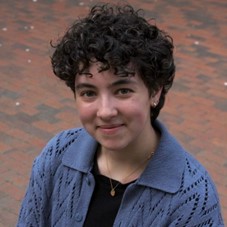
Audrey Bruening
Hometown: Parker, Colorado
Education: BA in sociology from North Carolina State University
Research Interests: survey design, criminology
Safiya: How did you become interested in survey design?
Audrey: My second year of undergrad, a survey design course was offered, and I signed up for it not knowing anything about the topic. I thought it could be useful for grad school and then I ended up absolutely falling in love with it. The faculty member who taught it, Dr. Yocom, became my mentor, and I wrote my honors thesis on cross cultural considerations. The words you use can be interpreted in so many different ways, and I think it’s super cool, kind of like a puzzle.
Safiya: So, it kind of sounds like you were also inspired by Don Dillman?
Audrey: Yes! I think in my thesis, I probably cited him on every single page at least five times.
Safiya: I’m sorry that you didn’t get the chance to interact with him, but his legacy still lives on here and there’s still a lot of Don Dillman in the department. On a lighter note, tell us a bit about yourself.
Audrey: I love animals; I have two cats. One is a little kitten that I just adopted over the summer, and he’s adorable. His name is Linus, and then my older one’s name is Olive. They’re best friends, and I think it’s very cute.
Safiya: How would you spend your ideal day?
Audrey: I probably would want to, obviously, wake up, then go get some breakfast, maybe waffles. And then, probably go for a hike or do something outdoors, because I feel like that’s a nice way to start your day. Maybe, if there is a giant cat adoption event, I could just go and see all the cutest cats ever. Then maybe a movie in the park could be fun. Then, probably dinner and board games with some friends and family. That sounds like a very good day to me.
Safiya: And have you been hiking around the Palouse yet?
Audrey: I went to Kamiak Butte, and it was super pretty. I was shocked at how tiny Pullman looks from way up there. Also, one morning, when we first moved here, I woke up super early because of the time change, and I was inspired to go for a run. So, while I was running, I saw this little trail and was curious to go see where it led. This was the Magpie Forest, and at first, you’re up high, then you go down, and you’re right next to the crops. As soon as I went down, I started remembering that I saw a Facebook post that someone saw a mountain lion, and then I was like, ‘I’m about to get eaten by a lion while I’m down in this valley where the grass is as tall as me!’ So, I sprinted out of there and called my mom because I was so scared I was about to get pounced on.
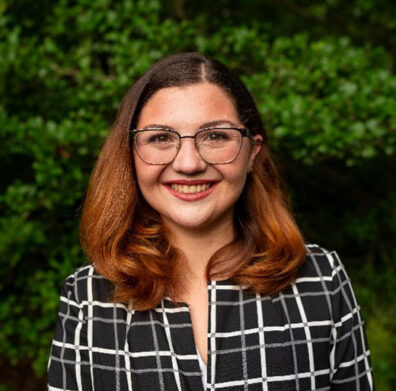
Bronwyn Hines
Hometown: Princeton, New Jersey
Education: BA in sociology and psychology from Skidmore College
Research Interests: mental health disparities, stigma, addiction, medical sociology
Safiya: What are you looking forward to studying, and how did that develop?
Bronwyn: I really want to study mental health, but from a sociological perspective. I double majored in both psychology and sociology, but I really had this awakening when I worked in an eating disorders unit at a hospital in New Jersey. To be honest, I didn’t do it for very long, only four or five months. It was really hard to watch how they would treat patients. I realized that I didn’t want to work in the system, I wanted to help change the system, and I felt like doing research from a sociological perspective on mental health would be the best way to focus on highlighting the problems in the system.
Safiya: What is something you have strong opinions about?
Bronwyn: Well, I am a very opinionated person, so it is difficult to narrow it down, but in relation to my research interest, I am definitely more of a nurture over nature kind of person. I don’t really like the idea of making everything about biological determinants, I think that it’s limiting. I believe that we are very moldable, and something that made me realize how much power we have is that I took this class in undergrad called Sociology of Emotions, and I learned that your emotions only last for seconds at a time. If you feel your emotions beyond a few seconds, it’s because something is retriggering it for you, whether it’s your own thought patterns or something else like your environment. It made me realize I have control over my emotions, so I feel like that’s one of the biggest things I’m very passionate about, is that you really do have the power in your own life.
Safiya: Tell us a little more about yourself and your interests beyond school.
Bronwyn: Fun thing about me is that I’m a singer; I’m a classically trained soprano. I am also a singer that has public performance anxiety, so that’s a really fun combination! I definitely have gotten better at that, but I’ve always been afraid to sing in front of other people. I also really like to swim—I think swimming is great fun. I’m also obsessed with cats; I have two cats! I know a lot of fun cat facts: the frequency of a cat’s purr can actually promote bone growth, which is super wild. I also draw, mostly portraits. I’m just a generally creative person, so I try to devote some time to those aspects of my life as well.